
A business broker acts like a specialist intermediary for smaller, “Main Street” companies, guiding owners through valuation, marketing, buyer screening, negotiations, and closing for relatively simple deals.
In contrast, an M&A advisor (mergers and acquisitions advisor) handles larger, more complex transactions, offering deep financial analysis, strategic positioning, buyer targeting, and deal structuring for mid-market and corporate clients.
In practice, business brokers dominate the volume of small business transactions, handling about 80% of M&A deal volume, though they account for only a small share of total deal value, while M&A advisors focus on high-value, sophisticated sales that often require institutional buyers and intricate deal terms.
Who you hire to run a sale shapes value, timing, and the odds that a deal finishes.
Choice of specialist changes the buyer pool, financing expectations, and due diligence depth.
That shift affects net value, the length of the process, and the likelihood of closing without surprises.
A local mechanic buying a single garage is a clear fit for a broker: limited capital, simple evaluation, and a short list of local buyers.
By contrast, an auto firm assembling a multi-city network needs an M&A advisor for strategy, larger capital, and longer planning horizons.
Real estate mirrors this: a single shop sale is straightforward, while financing a block of shops requires institutional buyers and advanced structuring.
So, what does a business broker do? Owners of single-location operations usually turn to local specialists to reach nearby buyers and close straightforward transactions. A clear, listing-driven approach helps keep deals confidential and focused on practical outcomes.
Typical size: most engagements handle Main Street deals up to roughly $1M–$2M (commonly cited under $3M).
Typical profiles include owner-operated firms with one location and simple operations. The buyer pool tends to be local entrepreneurs and individual investors seeking hands-on opportunities.
Common industries are local services, retail shops, casual restaurants, and other community-centered operations where personal relationships and location matter.
At heart, a business broker is a marketing and matchmaking professional. Core services include preparing a concise listing package, posting to sale platforms and local networks, and managing inbound inquiries.
They qualify prospects, arrange introductions, and coordinate offers and basic due diligence. The role focuses on keeping communication flowing and moving the transaction toward close.
Boundaries: brokers rarely do deep financial modeling, complex deal structuring, or manage multi-party institutional diligence. Compensation is usually a success-based commission, aligning incentives to complete the sale.
Larger transactions demand a disciplined process that protects value and coordinates many professional teams. An m&a advisor acts as a strategic and financial partner for mergers and acquisitions built for complexity, confidentiality, and value maximization.
Deals commonly range from a few million to tens of millions in enterprise value, often cited around $2M–$50M. These engagements cover multi-location firms, multiple stakeholders, and rigorous due diligence.
Buyers at this level include strategic acquirers and private equity groups that expect institutional-quality materials and a controlled process.
M&A advisors provide valuation (usually EBITDA-based), positioning, target lists, and management presentations. They run the outreach, cultivate competitive tension, and lead complex negotiations toward close.
They also coordinate attorneys, accountants, lenders, and compliance workstreams to reduce delays and surprises.
Targeted outreach matters: reaching the right buyers protects confidentiality and drives higher offers. Advisors design deal structures, earnouts, rollover equity, and staged payments, that can lift headline value but need careful tradeoffs.
Scale and complexity reshape every step of a sale. The size of your company and the buyer pool determine valuation methods, outreach style, and how much documentation is needed.
Below are the practical contrasts that change outcomes for sellers and their teams.
Main Street transactions are typically single-location and simple. Middle-market deals involve multi-site operations, layered management, and more moving parts.
Owner-operated firms often need matchmaking and listing exposure. Multi-location companies require strategic positioning and competitive processes to attract institutional buyers.
Smaller sales lean on simple multiples and comps. Larger deals use EBITDA and forward-looking models tied to growth and synergies.
Broad listings fit straightforward sales. Confidential, targeted outreach suits higher-value transactions and protects critical data.
Due diligence ranges from basic document checks to managed data rooms and proactive risk mitigation.
.webp)
Valuation methods change with buyer type, deal structure, and the risks a sale presents. Value is not a single figure; buyers model cash flow, growth expectations, and deal terms differently. That is why methods differ between local specialists and institutional-grade consultants.
For smaller transactions, simple, present-focused metrics dominate. Revenue and profit trends set a baseline.
Location, foot traffic, and owner dependence shift buyer interest and multiples.
Comparable sales (local comps) provide practical pricing anchors for hands-on buyers with limited financing.
For larger deals, valuation centers on forward cash generation. Advisors model EBITDA, growth forecasts, and scalability.
They quantify synergies a strategic buyer can extract and value intangible assets like brand, contracts, and proprietary processes.
Upfront investment needs, capex, systems, staff, are deducted from enterprise value or negotiated into deal structure.
A clear map of who handles each step helps owners pick the right path and set realistic timelines. Below is a high-level workflow that shows where different specialists concentrate effort and where added expertise changes outcomes.
The typical process runs: preparation, valuation, marketing, buyer qualification, LOI/offers, due diligence, definitive agreements, closing, and transition.
Brokers typically focus on preparing marketing materials, listing the opportunity, responding to inquiries, and screening prospects. They manage calls, site visits, and basic document coordination to get to a signed LOI and close.
This approach is efficient for simple operations, few stakeholders, and when speed and local exposure drive success.
M&A advisors engage earlier with strategy, timing, and positioning. They build a buyer thesis and run targeted outreach to create competitive tension.
Advisors manage valuation, organize data rooms, anticipate questions, and coordinate accountants and attorneys. That lowers the risk of late-stage re-trades and surprises.
They also negotiate deep terms, price, risk allocation, working capital mechanics, and transition expectations, and often support post-close continuity for employees and customers.
Elite Exit Advisors helps you choose the right exit path with a clear view of scale, complexity, and what the owner wants to achieve. The choice affects value, timing, confidentiality, and the odds a deal closes.
Practical evaluation: we assess readiness, likely buyer pools, and the simplest route to maximize value without adding needless complexity.
Matched marketing: broad exposure for smaller listings or confidential targeted outreach for larger, strategic processes.
Execution clarity: timeline planning, documentation standards, and a communication cadence that keeps owners informed and momentum moving.
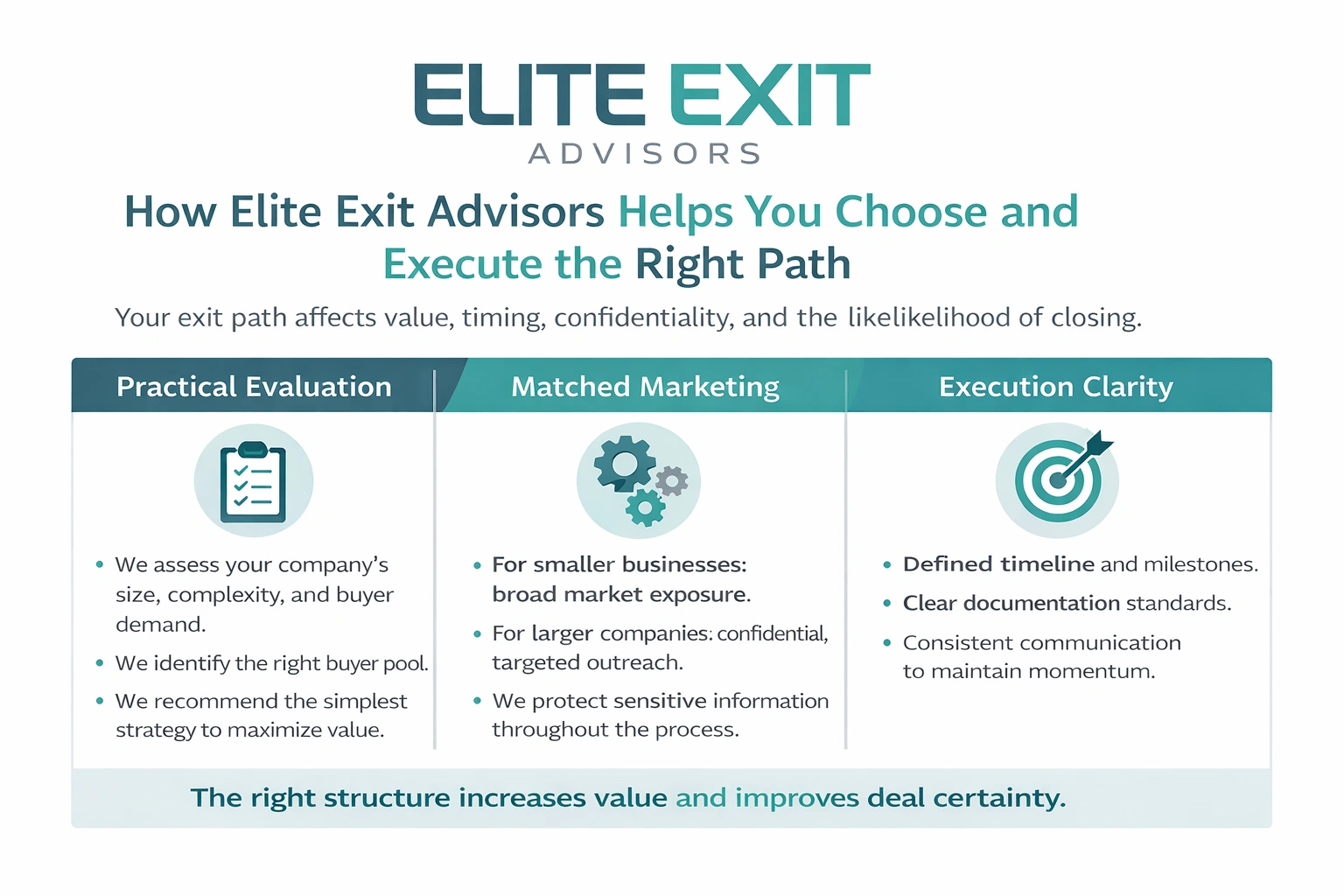
The structured support you can expect includes:
Next step: Book a call with Elite Exit Advisors to align goals with an exit plan built to close.
Deciding who runs your sale should start with an honest look at scale and risk. Smaller, local transactions often suit brokers who use listing-driven marketing and simple valuation multiples. Larger, complex deals benefit from m&a advisors who build targeted outreach, forward-looking valuation, and coordinated diligence.
Match the choice to size, buyer pool, confidentiality needs, and desired negotiation depth. Expect different compensation models too; commission-only for simple listings and retainers plus success fees for longer advisory engagements.
Use this guide’s section-by-section criteria to self-assess what your company needs before outreach. The right professional reduces surprises in data, documentation, and negotiations and raises the odds your deal closes with preserved value.