

An exit planning advisor is a specialist who helps business owners design and execute a strategy to exit their company at the right time, for the highest possible value, while protecting personal wealth and legacy. This business exit planning includes preparing the business for sale, improving valuation drivers, structuring succession, and aligning financial and personal goals long before an exit happens.
Most owners are unprepared; less than half (47%) of affluent business owners in the United States have a plan for exiting their business, putting them at risk of rushed sales, lower valuations, or forced exits when unexpected events occur.
Too many business leaders plan to step away without a clear, documented route to get there. Treating a future transfer as a single event risks lost value, unhappy staff, and surprises in the deal process.
Think of this work as ongoing business improvement. It strengthens operations, lowers owner dependence, and raises performance well before any sale.
A written approach creates accountability, sets timelines, and aligns external advisors. Relying on memory leaves gaps; written steps allow coordinated execution and measurable progress.
Success is more than price. It should preserve continuity for employees and customers, reduce personal financial risk, and use tax-aware choices. It should also create options, full sale, partial liquidity, internal succession, or a family handoff, so owners control their future.
Quick comparison of outcomes with and without a documented plan
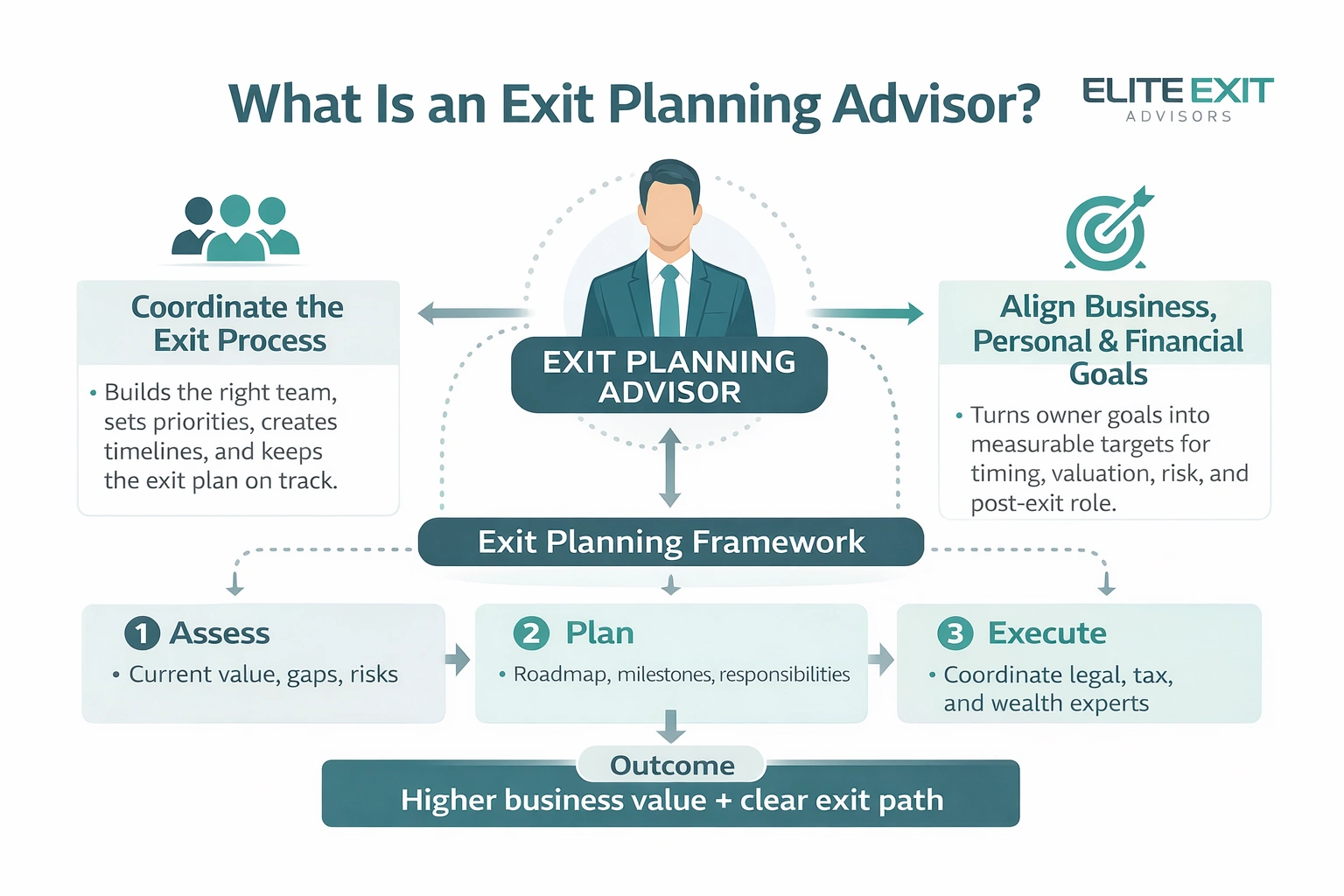
A dedicated professional turns a vague departure idea into a step-by-step roadmap that owners can follow. In practice, an exit planning advisor is the person who orchestrates and manages a structured process across business, personal, and financial dimensions.
The coordinator role is hands-on. They assemble the right team, set priorities, and create a clear roadmap with timelines and milestones.
The leader keeps tasks on track and prevents work from stalling. Typical deliverables include assessments, an action plan, and a cadence of review meetings.
Good advisors translate broad goals into measurable targets: timing, required proceeds, risk tolerance, and the owner’s desired post-transition role.
The three-alignment approach connects business goals (value and transferability), personal goals (lifestyle and identity), and financial goals (independence from the company).
A higher sale price is usually the result of steady operational fixes and risk reduction implemented years ahead. An expert-led process focuses resources where they move the needle: protect existing value, grow earnings, and prepare the company for monetization.
Protect means reducing risk and shoring up weaknesses that cut buyer offers.
Grow targets durable earnings and customer stability to lift multiples.
Harvest prepares documentation, deal-ready reporting, and packaging so value converts to cash at sale.
Transferable value shows up as repeatable processes, clear reporting, and strong management that runs without the owner. Buyers pay more for predictable cash flow and customer relationships that stick.
Addressing Death, Disability, Divorce, Distress, and Disagreement is a value strategy, not just emergency cover. About half of owners face one of these events, and each can lower offers or add deal conditions.
Better margins, cleaner financials, and operational discipline often boost owner cash flow today. Those improvements also raise enterprise value over time.
The most durable approach rests on three pillars that work together. First, make the company transferable so buyers or successors can operate it without the owner. Second, ensure the owner has financial independence once they leave. Third, design a meaningful next chapter that fits family goals and purpose.
Business value means documented processes, consistent earnings, and leadership depth. These features raise offers and reduce due diligence friction.
Financial readiness defines the amount and timing of proceeds needed to replace income and secure wealth. This includes tax-aware choices and investment strategy.
What’s next addresses roles, identity, and family governance. A clear plan reduces conflict and protects legacy.
Different business exit paths change priorities. A third-party sale focuses on multiples and clean reporting. Internal succession needs leadership development and role handoffs. Family transfer adds governance, wealth transfer, and education. Partial liquidity blends short-term proceeds with longer-term ownership.
Legal structure, timing, and deal terms change net proceeds. Estate tools and tax strategy should be part of the same master plan so ownership transfers and family goals align.
Regular reviews keep the plan current with market shifts and family events. Staging work into milestones makes execution practical and measurable.
A company’s unseen strengths, people, customers, systems, and reputation, often set valuation multiples. Buyers focus on what makes cash flow durable and transferable. Intangible capital turns earnings into predictable value that lenders and buyers can underwrite.
Strong leadership bench strength and clear accountability reduce key-person risk. Retention plans, documented roles, and measured succession steps make a business far less dependent on the owner.
Long-term contracts, healthy renewal terms, and diversified customer mix lower buyer risk. Recurring revenue models improve financing outcomes and boost confidence during due diligence.
Buyers pay a premium for documented processes, operating rhythms, and KPIs that scale. Institutionalized know-how and reliable reporting help a company survive turnover and grow without the founder.
Reputation, culture, and trusted partner relationships expand the buyer pool and improve deal leverage. Social capital often shortens integration time and supports post-sale success.

Readiness gaps quietly erode sale outcomes long before a company hits the market. Owners often discover problems during diligence: unstable earnings, missing documentation, or unclear succession. Those issues turn potential value into negotiation leverage for buyers.
The Wealth Gap is the shortfall between what owners need for life after the company and their liquid holdings outside the business. Without a clear target, a sale can leave owners short of retirement goals.
Action: quantify required proceeds, run after-tax scenarios, and set milestones to close the shortfall.
The Profit Gap is the difference between current profits and achievable industry performance. Sustainable cash flow raises buyer confidence and gives owners leverage in sale timing and terms.
Action: stabilize margins, clean up reporting, and document repeatable revenue streams to show durable EBITDA.
The Value Gap measures how much higher a company could sell for if risk declines and intangible capital improves. Buyers underwrite deals and focus on predictable EBITDA, quality of earnings, and risk-adjusted returns.
Action: reduce concentration risk, strengthen management, and produce deal-ready financials to lift multiples.
About 80% of businesses that go to market fail to complete a transaction. Gaps in wealth, profit, and value commonly explain this. Lenders and buyers walk when forecasts or controls look unreliable.
Result: structured assessment plus disciplined execution turns abstract goals into a staged roadmap that improves sales odds and owner outcomes.
Hiring the proper specialist ensures technical know-how and people skills work together during a transfer. Owners should evaluate four core areas: training credentials, real-world experience, process discipline, and the ability to coordinate specialists across finance, legal, and wealth management.
CEPA training is broad and technical. The program was created in 2007 and uses an intensive, five-day, MBA-style format that covers 23 key areas and ends with a 150-question exam.
Topics include value acceleration, estate concepts, deal mechanics, and coordination methods. This breadth matters because transfers touch taxes, governance, and human dynamics.
Look for professionals with real owner-facing experience. Many candidates have at least five years working directly with business owners, which matters because numbers and people both shape outcomes.
Ask for examples of prior engagements, measurable outcomes, and references from owners who completed a transfer.
Tip: Prioritize professionals who show process discipline and a team-first approach. That reduces duplication, closes gaps, and helps a company and family move forward with confidence.
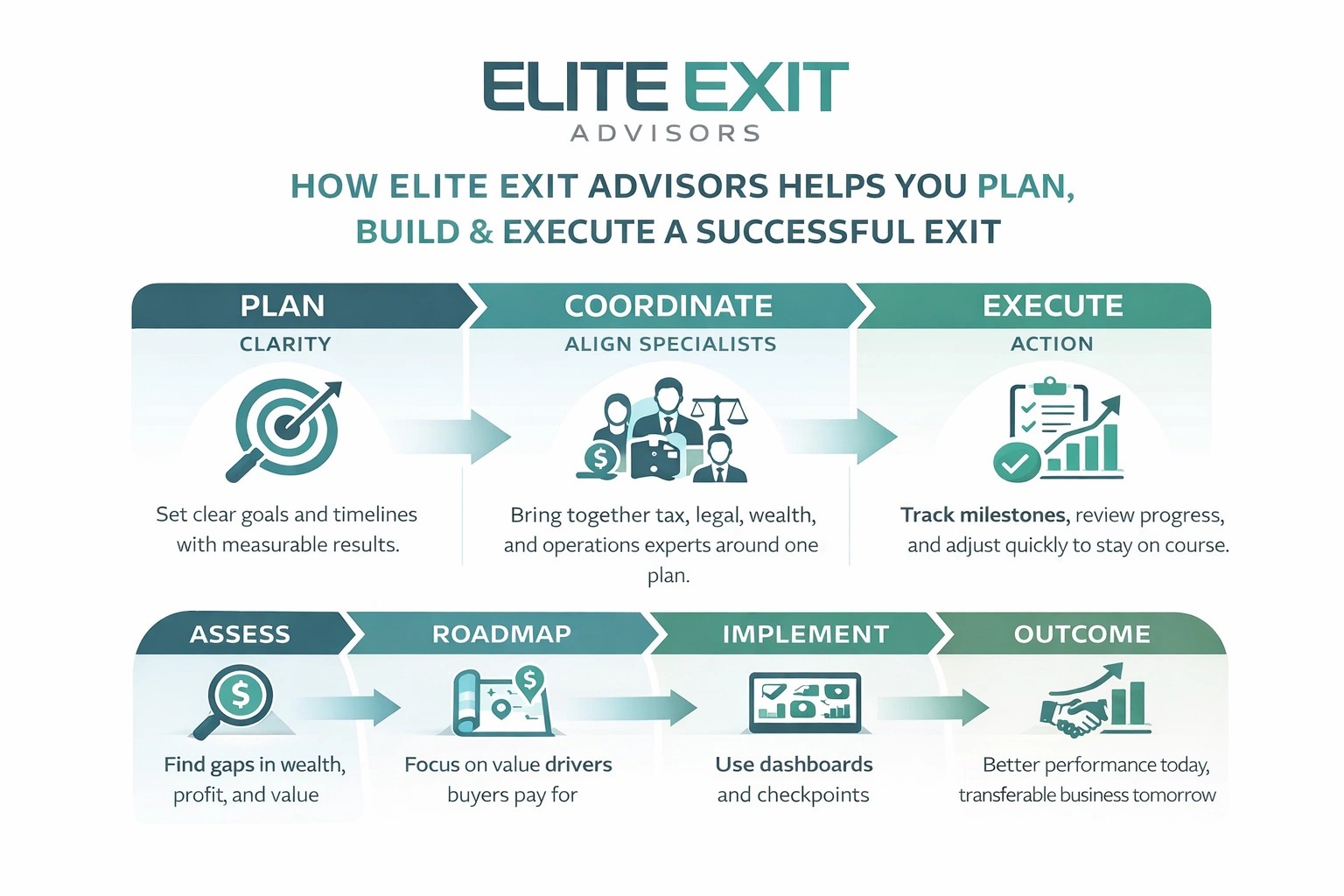
A focused roadmap turns long-term aims into monthly actions that produce measurable results. Elite Exit Advisors acts as the coordinating hub that keeps work moving from assessment to action. That prevents good plans from stalling and turns targets into outcomes.
We clarify owner goals and timelines so every task ties to a measurable result. Then we align the right specialists, tax, legal, wealth, and operations, around one actionable plan.
Relentless execution means milestone-based accountability, a review cadence, and rapid adjustment when priorities shift. This keeps momentum over months and years.
How Elite Exit Advisors helps:
Ready to move from intent to results? Book a call with Elite Exit Advisors to discuss goals, timelines, and the first practical steps toward a buyer-ready business and a successful transition.
Early, structured work turns vague goals into concrete options and measurable value.
Exit planning is an ongoing business strategy that strengthens operations now while preparing for a smooth transition later. A dedicated advisor coordinates goals, reduces risk, and creates a clearer path to transferable value.
Remember the building blocks: value-acceleration actions, the three legs of a solid plan, and the Four Cs that buyers reward: people, customers, systems, and reputation. Without preparation, owners face lower valuations, more deal friction, and a higher chance a business exit never closes.
If you want clearer priorities and better outcomes, speak with Elite Exit Advisors to start a written plan and begin disciplined execution toward your future options.